Three Approaches to Promoting Safety
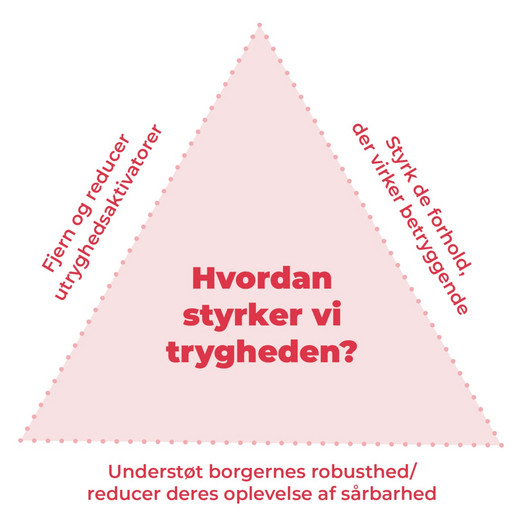
The Safety Triangle is a tool that can be used to analyze and pinpoint the reasons why certain places and urban or residential areas are perceived as unsafe. At the same time, it serves as a tool to develop comprehensive, targeted safety measures in urban planning.
The Safety Triangle helps us understand why feelings of insecurity arise. This feeling occurs at the intersection of three conditions: 1) a vulnerable individual combined with 2) a safety activator and 3) an absence of reassuring factors.
A Vulnerable Individual
Vulnerability to insecurity is linked to how vulnerable we feel. This vulnerability can, for example, depend on our assessment of crime risk, the consequences of a traffic accident, or our perception of control and ability to prevent an unsafe situation. Therefore, insecurity is influenced by factors such as age and gender, experiences with crime, media consumption, social capital, socioeconomic resources, and the extent of crime and social problems in one’s neighborhood.
Safety Activator
The events or conditions that trigger feelings of insecurity are called safety activators. These can include:
- Physical conditions, e.g., darkness, places that appear deserted, disorderly places with poor visibility, or streets perceived as dangerous for pedestrians;
- Groups of people, e.g., the presence of people who behave differently or look different from the majority;
- Specific areas or places, e.g., neighborhoods with a bad reputation or unfamiliar places;
- Crime (or signs of crime) such as shouting, burglaries in the neighborhood, reckless driving by car or bicycle, and vandalism.
Absence of Reassuring Factors
Feelings of insecurity only arise if there is also an absence of reassuring factors in the situation: For example, there may be no other people present or “eyes on the street.”
Three Approaches to Promoting Safety
Based on the Safety Triangle, we can derive three approaches to safety-promoting and insecurity-preventing urban planning. These can be addressed individually or collectively and at different scales. As discussed in chapter three, a range of general safety-creating measures can reduce safety activators and ensure reassuring conditions through local planning. It is advisable to find interventions that positively support each other.
Remove and Reduce Safety Activators
Once safety activators are identified, you can work purposefully to remove or reduce them. This might include removing graffiti from the area, introducing traffic calming measures to prevent reckless driving, or trimming vegetation that obstructs visibility.
Strengthen Conditions that Provide Reassurance
Reassuring conditions can vary in scale. Larger efforts might be a new road and pathway system that creates a flow of people through an area or establishing better conditions for life in the neighborhood, as human presence provides reassurance. Smaller measures might include keeping hedges low or removing coverings from shop windows to increase natural surveillance.
Support Residents’ Resilience / Reduce Their Sense of Vulnerability
This can be done through safety-promoting communication that dispels media-created misunderstandings and exaggerations about the risk of crime. Perhaps the neighborhood is not as dangerous as people think! Social housing initiatives can also play a role in supporting residents’ resilience.
References
- Scherg, R.H. (2018) Skræddersyet tryghed: Et situationelt perspektiv på det tryghedsskabende arbejde.
- Scherg, R.H. (2018) Skræddersyet tryghed: Et situationelt perspektiv på det tryghedsskabende arbejde og Scherg, R.H. (2016) Utrygheden finder sted: En undersøgelse af utryghed ved kriminalitet med særlig fokus på udforskningen af utryghedens rumlige dimensioner og miljømæssige årsager. Aalborg Universitetsforlag.
- Scherg, R.H. (2018) Skræddersyet tryghed: Et situationelt perspektiv på det tryghedsskabende arbejde, se også Justitsministeriets Tryghedsundersøgelse 2022 – En måling af trygheden og tilliden til politiet i hele Danmark, i politikredsene, i de 98 kommuner og i de særligt udsatte boligområder.